
The Best Board Games for Practicing Colors
There are so many social benefits to playing board games with your kids - particularly with the bonding that takes place during a family game night. Playing games together is first and foremost supposed to be fun, and it is, but it’s also entirely worth mentioning all of the academic benefits of board games at the same time.
Board games can teach children so many different academic skills, and do it so well, that there is even an entire style of homeschooling dedicated to it - gameschooling. But you certainly don’t have to homeschool your kids to benefit from gameschooling. You can reap the many benefits of playing games together anytime at all. Or, if you’re a teacher, you can try to bring more games into the classroom. And I personally think the benefits are the most obvious with preschool games.
One of the basic skills that preschool board games are notorious for incorporating is color recognition. Say what you will about the classic Candy Land (I, for one, am not a Candy Land hater) but it absolutely helps kids practice their colors in an engaging way. And since that classic game came out, there have been many more games that practice colors with very creative themes and beautiful components.
Our 3-year-old daughter is currently at the perfect age to really benefit from the basic academic skills of gameschooling, so we are knee-deep in family games that help with numbers, colors, shapes, and more. We’ve built a large collection of games for kids that’s been growing ever since our son was 2 - and we’ve been able to see which games both of our kids tend to return to over and over again.
The games on this list, as is the case with all of our lists, are some of our very favorite family board games. They don’t merely fit the theme of teaching colors, they are also games that we love and all enjoy playing together. Hopefully it helps you discover a new game for your young ones’ gameschooling routine, or perhaps a new game to bring into your classroom.
Disclosure: Some of the links in this article are affiliate links. Clicking on those links will lead you to view the games’ listings on Amazon.

Color It!
Designed by Lena & Günter Burkhardt and Published by HABA
Color It! is a new game from HABA that’s a perfect fit for this gameschooling list. Not only does it help practice colors - it has the added bonus of practicing numbers and even fine motor skills. Plus, it’s coloring! Who can argue with that? And it’s truly a fun and relaxing activity to do with the little ones. Our daughter plays it with such a delightful focus.
Everyone has their own coloring sheet in front of them - full of blank spaces that are numbered. On your turn you roll the dice and get a combo of numbers and colors. You then must color one of the appropriate spaces on your sheet with one of the colors that you rolled. There are technically ways to win the game, and a variation you can try to increase the challenge, but you can also completely ignore winning and just do it for the fun of it. Color It! is officially recommended for ages 4 and up, but you could go lower than that if you have a little one that likes to color.

Snail’s Pace Race
Designed by Alex Randolph and Published by Ravensburger
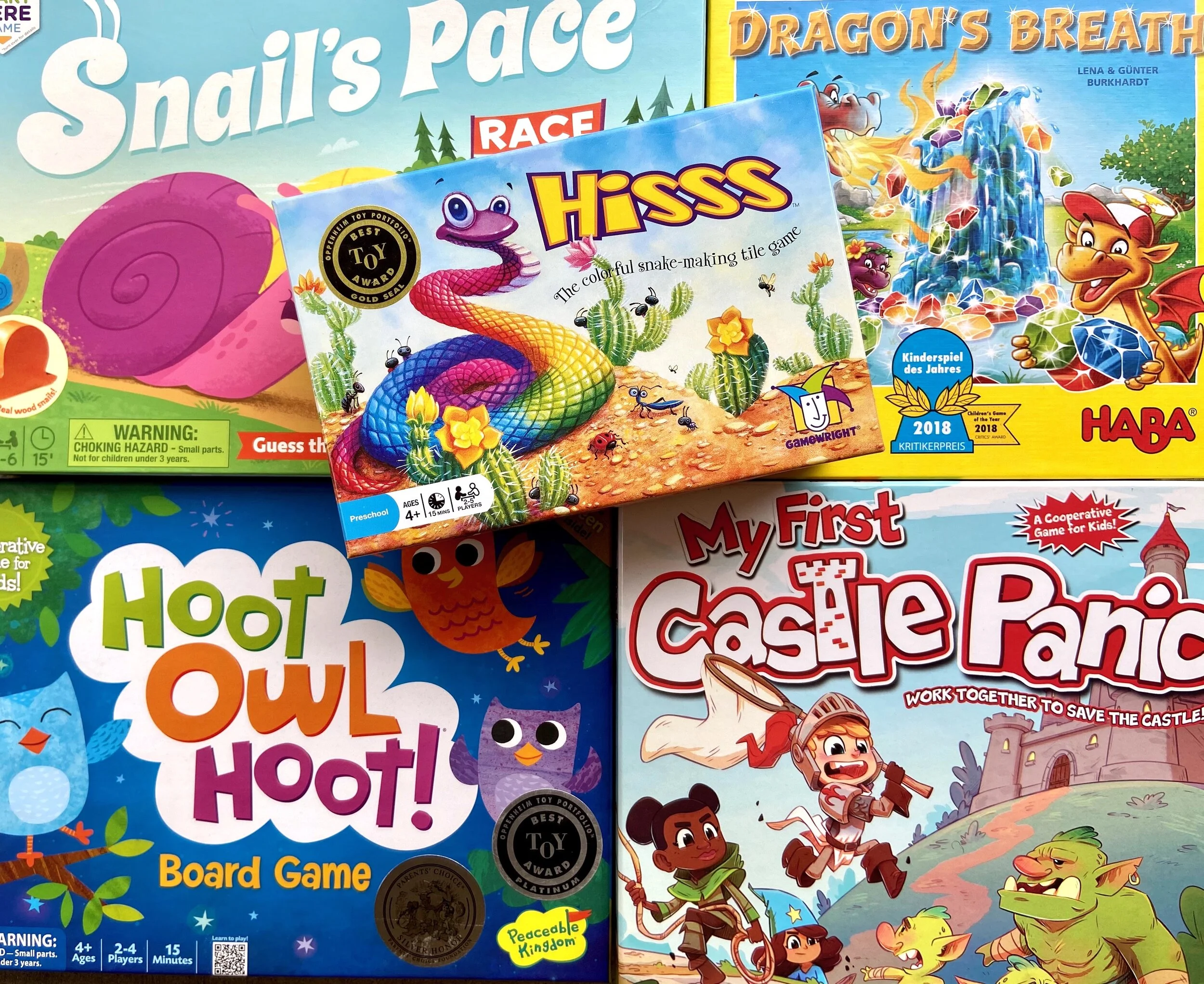
Snail’s Pace Race is a classic and it is definitely the simplest game on this list, but sometimes that’s exactly what you need. It would make a terrific first board game for a child, because primarily what they will work on is taking turns, rolling the dice, moving pieces, and, of course, color recognition. Whichever color you roll is the color of snail that moves closer to the finish line, and that’s all there is to it.
There are a total of 6 different colored snails in the game, and you always play with all 6 of them on the board - which is great for your color practice. Before the game begins everyone chooses a different colored snail to cheer for. Then you take turns rolling the two dice and moving the appropriate snails. It’s actually a lot of fun to play with a little one, because it’s hard not to root for your snail - regardless of how simple the game is.

Hoot Owl Hoot!
Designed by Susan McKinley Ross and Published by Peaceable Kingdom
Hoot Owl Hoot! is one of the first board games we ever bought for our son and it’s made by one of our favorite publishers - Peaceable Kingdom. It also made our list of the best board games for 3-year-olds. As is always the case with Peaceable Kingdom, Hoot Owl Hoot! is a cooperative board game where everyone either loses or wins together. And we’ve always liked that because of the teamwork involved, and the increased focus on simply having fun together.
Hoot Owl Hoot! is a game about getting baby owls back to their nest before the sun comes up. Similar to Candy Land, you draw a card and move the owls to the next available space of that color. One big difference however, is that you can move any of the owls you want, and it’s great practice in strategy to figure out together which owl you should move. This is a very well-designed game with obvious gameschooling possibilities for the little ones.

Hisss
Designed by Brigitte Pokornik and Published by Gamewright
Hisss is a newer addition to our family’s game collection, and I’m glad we got our hands on it while our daughter is still 3. It’s a very simple game to explain but very effective at practicing colors. But it’s also an attractive and elegant game that’s engaging enough for her older brother and for us as well. In fact, my wife and I have even enjoyed playing it by ourselves.
Hisss is a snake-building game with tiles that have colorful snake parts on them. On your turn, all you have to do is draw a new tile and place it on the board. You have to connect your new piece to an existing snake-in-progress by matching colors, or start a new snake. If you complete a snake you get to keep it, and that’s pretty much all there is to it. Oh, and there’s lots of hissing going on as well. It’s a terrific gameschooling game for practicing colors, and it also helps with spatial awareness and focus as well.

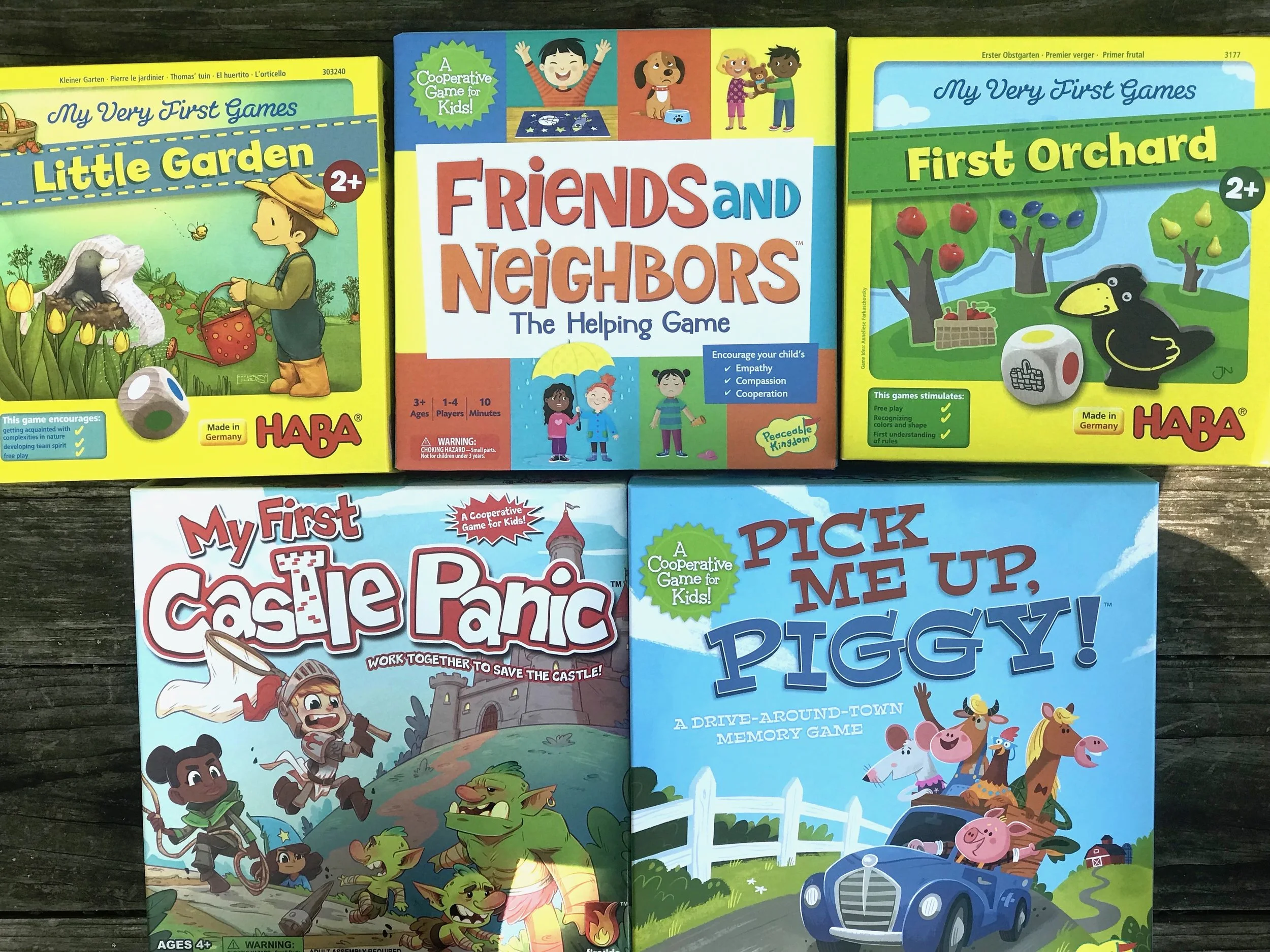
My First Castle Panic
Designed by Justin De Witt and Published by Fireside Games
If you’re a regular reader, there’s no doubt that you’ve seen us mention My First Castle Panic before. It’s definitely one of our favorite board games for children for a variety of reasons, and it made our list of the best board games for 3-year-olds. It has a great fantasy theme, quality presentation, and engaging gameplay. A fantasy game with goblins trying to destroy your castle is very much up our alley. And, as an added bonus, it’s a great way for your kids to practice matching both colors and shapes.
My First Castle Panic includes the colors red, blue, and green, and a big part of the mechanics of the game involves the ability to match the colors on your cards to the appropriate spaces on the board. At the same time, your kids will also be matching circles, squares, and triangles - so it’s pretty clear that My First Castle Panic is an excellent preschool board game for gameschooling.

Dragon’s Breath
Designed by Günter and Lena Burkhardt and Published by HABA
Since Dragon’s Breath is published by HABA, you can be certain that the components will be top notch. The wooden dragon and the colorful crystals really make this game stand out and endear it to our daughter. And it also earned a well-deserved spot on our list of the best board games for 3-year-olds.
It’s a perfect game for our daughter in many ways - not the least of which is the opportunity to practice her colors. But I also love the fact that she gets to work on her motor skills, and it’s adorable seeing little preschool hands trying to carefully remove a ring of ice or scoop up the correct color of crystals.
After each round of Dragon’s Breath, each player chooses a new color of crystal for the round. When the dragon removes a layer of ice and the crystals come tumbling down, each player is supposed to grab only the crystals that match their color. There’s great visual strategy and dexterity components to the game as well - and our daughter comes back to this one all the time.

Candy Land
Designed by Eleanor Abbott and Published by Hasbro
Like I mentioned before, I’m no Candy Land hater. I honestly can’t understand the hate it gets. There are many, many poorly designed games created to make parents pull their hair out (don’t get me started on Trouble) but Candy Land simply isn’t one of them. It’s quick and simple and effective - and those aren’t bad qualities. I think sometimes people forget that it’s a game designed to be played with your toddler and it does what it does well.
Depending on the version you get, the art is generally really enjoyable. I love the characters in Candy Land. And who doesn’t get excited about drawing one of the rare special cards and jumping ahead. But, most importantly for our purposes here, the system for moving is fantastic practice for color recognition. And when we’re done I’m happy to play again which is definitely not something I can say about all games. I’m looking at you, Trouble.

Monza
Designed by Jürgen P. Grunau and Published by HABA
Monza is a car racing-themed game - but in my mind I think of it as a creative and more strategy-filled version of Candy Land. Similarly, both games have a grid of colors for advancing your game pieces. But instead of drawing a single card and moving to the appropriate square, you actually roll several dice in Monza, and then have many colors to work with.
The strategy comes into play with the order that you play your colors - and which path you take. You often have to make a choice about which color to move to next, and putting your dice in the right order can make a difference with how far you get to move that turn. Both my 8-year-old and my 4-year-old still love to play this game. It has the same color practice as Candy Land with the added bonus of a little strategic thinking and spatial reasoning.

The Color Monster
Designed by Josep M. Allué & Dani Gómez and Published by Devir Games
This one is based on the very popular and amazing picture book The Color Monster, and I think they did a fantastic job translating it into a game. As you can imagine if you’ve read the book, the game focuses a great deal on emotions. And you likely know how much I love talking about empathy. The Color Monster is therefore not only a great gameschool game for colors, but a wonderful opportunity to talk about feelings as well. Without a doubt it should be on the radar of school counselors.
It’s basically a matching game - moving the Color Monster around the board and trying to match the correct feeling to the correct jar. And just like the book, every feeling (anger, sadness, joy, etc.) is represented by an appropriate color. In order to do complete your turn, you also have to talk about things that make you feel that particular way - which is perhaps the highlight of the game. Unless of course you count the amazing components in the box. The Color Monster himself is an amazing piece to play with during the game or even afterwards.
What are you favorite games that teach colors? Have you played any of our favorites? Let us know in the comments!